A pair of loppers and a free Saturday afternoon can do a lot of good in a garden. They can also set a tree back by years. Most of the damaged trees we hear about didn't suffer from disease, drought or bad luck — they were cut badly, at the wrong moment, by someone with the best intentions.
The encouraging part is that all five of the mistakes below are easy to avoid once you know what you're looking at. Here's what goes wrong, and what to do instead.
1. Pruning at the wrong time of year
This is the quiet one. A tree pruned in the wrong month often looks perfectly happy for a season, then declines slowly, and by the time the cause is obvious the wound is old.
Timing matters because trees seal wounds differently through the year, and because some diseases are far more active in certain conditions. Silver leaf and bacterial canker, for example, spread most readily through wounds made in damp, cold weather — which is exactly when many people reach for the saw.
As a rough guide for UK gardens:
- Plums, cherries, apricots and other stone fruits: prune in late June to August, when the tree is growing strongly and spores are less of a threat.
- Birch, acer and other "bleeders": wait until mid-summer to early autumn, or after leaf fall. Cutting them in late winter means sap pours from the wound.
- Most other deciduous trees — oak, ash, hawthorn, willow: the dormant season, roughly November to February, avoiding hard frosts.
- Evergreens: late spring, once sharp frosts have passed.
- Spring-flowering shrubs and small trees: straight after flowering, so you don't remove the buds that would have bloomed next year.
One more thing: from March to August, assume there could be a nest in the tree. Wild birds' nests are protected while in use, so check carefully before you cut — and if you're unsure, postpone the work until autumn or take advice.
2. Flush cuts and leftover stubs
A flush cut slices the branch off level with the trunk, as neatly as if you were trimming a hedge. It looks tidy. It is also a serious wound.
Where a branch meets the trunk, most trees form a swollen ridge of tissue called the branch collar. That collar is the tree's own sealing mechanism. Cut it away and you leave a wide wound with no defence, and decay can move into the trunk rather than stopping at the joint.
Leaving a long stub is the opposite error, and it causes similar trouble. The tree can't seal a stub, so it dies back, rots, and often sends up a cluster of weak shoots that will need removing later.
The aim is a cut just outside the collar, not through it. For anything larger than your wrist, use the three-cut method:
- Make an undercut about a third of the way through the branch, a hand's width out from the trunk.
- Cut from above, slightly further out. The branch drops without tearing a strip of bark down the trunk.
- Remove the remaining stub with a clean cut just outside the branch collar, angled gently away from the trunk.
3. Taking off too much in one season
Leaves are the tree's kitchen. Strip away too many and you starve it, forcing it to spend stored energy on regrowth instead of roots and defences.
A sensible rule of thumb for mature trees is to remove no more than around a quarter of the live canopy in a single year — and less than that for older or struggling trees. If a tree needs serious reduction, spreading the work over two or three seasons is far kinder than doing it all at once.
Watch out for "lion tailing" too: stripping the inner branches and leaving a tuft of foliage at the tips. It exposes previously shaded bark to strong sun, which can scald, and it leaves long, whippy limbs that catch the wind.
4. Topping and lopping
Topping means cutting the main stems back to thick stumps. It's still sold as a way to control size, and it's still one of the fastest ways to ruin a tree.
The tree responds by throwing out dense, weakly attached shoots from the cut ends. Within a few years it's often taller and bushier than before, but now with a row of decayed stumps and a crown that catches wind badly. Topping also destroys the tree's natural shape permanently.
If a tree is genuinely too big for its spot, the better answers are usually crown reduction carried out properly — cutting back to suitable side branches, never to stumps — or thinning to let more light through without changing the overall size. Sometimes the honest answer is that the wrong tree is in the wrong place, and replacement with something smaller is the sensible long-term plan.
5. Blunt blades and dirty tools
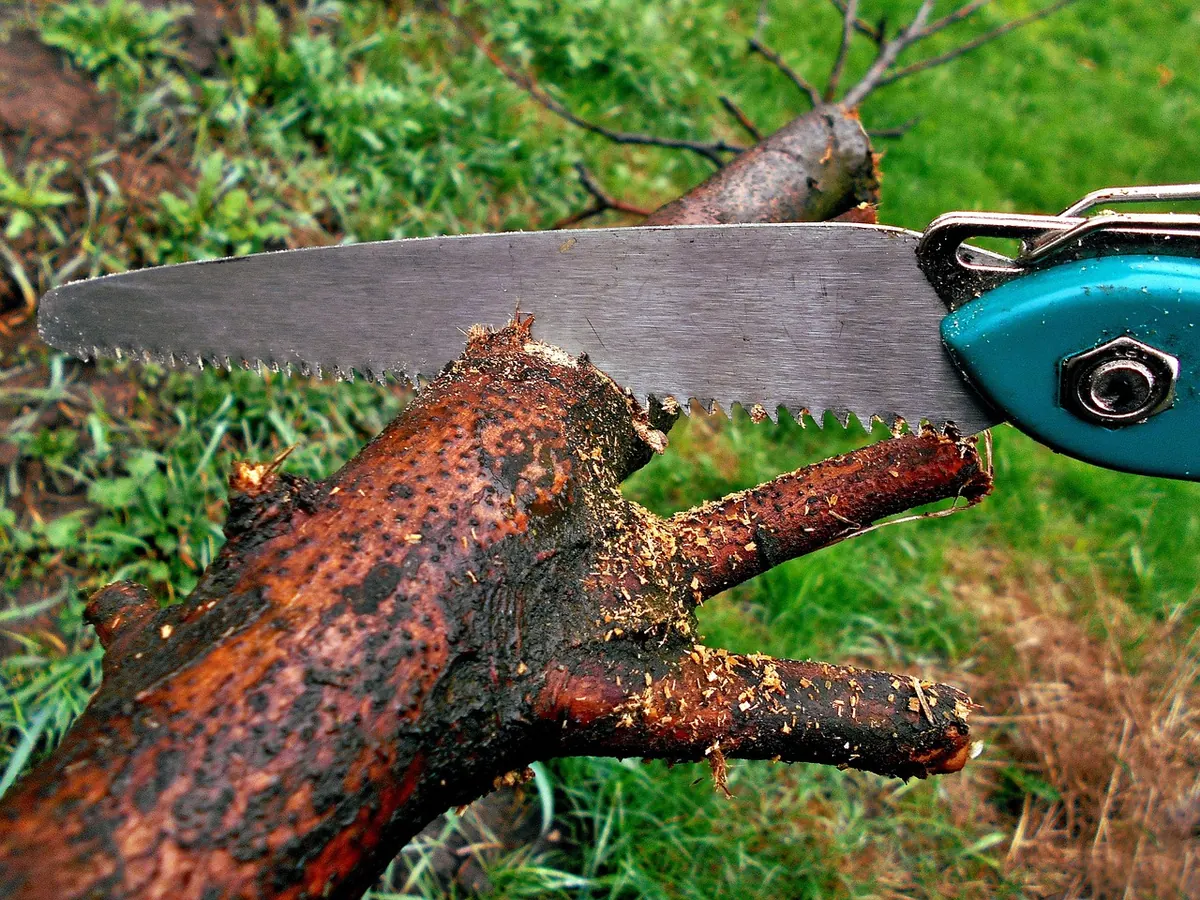
A blunt saw doesn't cut so much as chew. It crushes tissue, tears bark and leaves a ragged wound that takes longer to seal. Sharpen or replace blades before you start, and use a pruning saw for anything thicker than about 25mm rather than forcing a pair of secateurs.
Cleanliness matters just as much. Fungal and bacterial problems can travel between trees on blades, so wipe and disinfect your tools between specimens — particularly with fruit trees and any plant showing signs of disease. Follow the manufacturer's instructions for the disinfectant you use, and oil metal parts afterwards to keep rust at bay.
Never be tempted to seal a wound with paint or tar. Modern advice is to leave pruning cuts open to the air; dressings tend to trap moisture and slow the tree's own sealing process.
Prune less, and prune well
Good pruning is mostly about restraint. Decide what you're trying to achieve before you make the first cut — more light, clearance over a path, a damaged limb removed — then work to that goal and stop when it's met.
Before any significant work, check whether the tree is covered by a Tree Preservation Order or sits in a conservation area, as you may need consent from your local council first. And if the job involves ladders, chainsaws, or branches over a building or road, bring in a qualified arboriculturist with proper insurance. It's cheaper than repairing a roof, and much safer than a saw at height.
Trees measure time differently from us. A cut made well this winter will be invisible in five years; one made badly can shape the tree for the rest of its life.
Photo: JerzyGórecki / Pixabay